

GIA Certification Demystified: How to Read a Diamond Grading Report
A GIA diamond grading report contains more information than most buyers realize and understanding it prevents costly mistakes. The difference between a diamond that sparkles brilliantly and one that looks dull despite good grades often comes down to details buried in the report that most people never examine. The variation between two diamonds with identical "headline" grades (both 1.5 carat, G color, VS2 clarity) can mean thousands of dollars in value difference based on proportions, symmetry details, and other factors the certificate documents but doesn't advertise.
This guide walks through every section of a GIA diamond grading report, explains what each measurement means for the diamond's appearance and value, and teaches you to spot the details that separate exceptional diamonds from mediocre ones. Whether you're comparing diamonds online or evaluating stones in person at our Atlanta showroom, understanding how to read the certificate transforms you from trusting seller descriptions to making independent, informed assessments.
Why GIA Certification Matters
The Gemological Institute of America (GIA) established the diamond grading standards the industry uses worldwide. They created the 4Cs framework (Cut, Color, Clarity, Carat), developed the grading scales, and maintained the most consistent, conservative standards in diamond certification.
What Makes GIA the Gold Standard
Independence: GIA is a nonprofit educational institute with no financial interest in diamond values. They don't buy, sell, or broker diamonds. Their only function is unbiased assessment.
Consistency: GIA's grading standards remain consistent across decades and locations. A VS2 clarity grade today matches VS2 from 20 years ago. This consistency makes their reports reliable for insurance, resale, and comparison.
Conservative grading: When uncertain between grades, GIA defaults to the more conservative assessment. Other labs sometimes grade generously to please their clients (diamond sellers). GIA's reputation depends on accuracy over client satisfaction.
Global recognition: GIA reports are accepted worldwide. If you sell or insure your diamond internationally, GIA certification provides universal credibility.
Research leadership: GIA conducts ongoing research into diamond identification, treatment detection, and grading methodology. Their equipment and expertise remain industry-leading.
What Is a GIA Diamond Grading Report?
A GIA diamond grading report is like a diamond’s passport—a document that verifies its identity and quality. It includes:
-
Unique Report Number: Every diamond has a one-of-a-kind reference number, often laser-inscribed on the girdle.
-
Shape & Cutting Style: Round brilliant, oval, cushion, etc.
-
Measurements: Dimensions in millimeters.
-
Carat Weight: The diamond’s size measured precisely.
-
Color Grade: From D (colorless) to Z (light yellow or brown).
-
Clarity Grade: From Flawless (FL) to Included (I).
-
Cut Grade: For round brilliants, from Excellent to Poor.
-
Polish & Symmetry: Details of craftsmanship.
-
Fluorescence: Reaction to UV light (None, Faint, Medium, Strong).
-
Plot Diagram: A map of inclusions and blemishes unique to the diamond.
How to Read a GIA Certificate: Step by Step
Let’s break it down section by section, the way we would in a private consultation:
-
Start with the Report Number
-
This is your diamond’s fingerprint. Use it to verify authenticity on the GIA website.
-
Look at Shape & Measurements
-
Beyond carat, proportions affect how big the diamond looks on the hand. A well-cut oval, for example, can appear larger than a round of the same carat weight.
-
Review the 4Cs
-
Cut = Sparkle. Don’t compromise here. An Excellent cut will outshine larger, poorly cut diamonds.
-
Color = Purity. Near-colorless (G–H) often delivers best value without visible warmth.
-
Clarity = Cleanliness. Focus on eye-clean stones (VS2–SI1 range).
-
Carat = Size. Bigger isn’t always better. Balance size with cut quality.
-
Check Polish, Symmetry & Fluorescence
-
These factors fine-tune brilliance. At TaTe, we recommend Excellent polish and symmetry for maximum sparkle.
-
Understand the Plot Diagram
-
Think of it as your diamond’s “birthmark map.” No two are alike. This is also how jewelers confirm your diamond’s identity.
Sample Annotated GIA Report
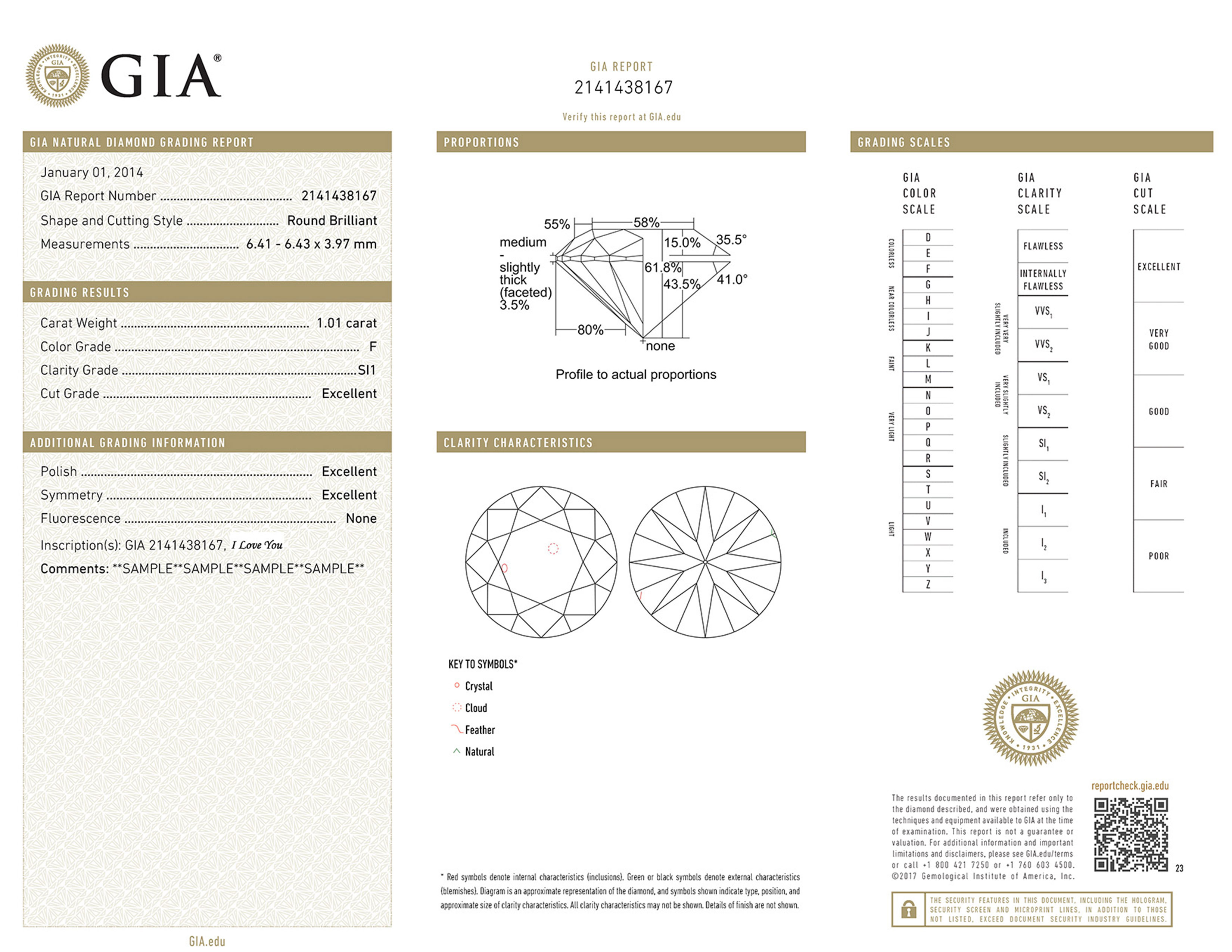
Pro Tip: During consultations at TaTe Diamonds, we walk clients through an actual report line by line so you leave with complete confidence.
How We Use GIA Reports at TaTe Diamonds
Every diamond we sell 0.30 carats and larger includes GIA or AGS certification. Here's how we use reports to ensure you get exceptional stones:
Pre-selection: We reject diamonds with marginal proportions, poor inclusion placement, or below Very Good polish/symmetry—even if the headline 4Cs grades meet requirements.
Client education: During consultations, we walk through reports section by section, explaining what each measurement means for the specific diamond you're considering.
Comparison shopping: We show multiple certified diamonds side by side with reports, demonstrating why certain combinations of proportions create superior light performance.
Verification: We verify laser inscriptions match reports and check GIA database before accepting inventory.
Transparency: We provide complete reports (not just headline grades) for every diamond. You're entitled to see exactly what you're buying.
Your Action Steps
When shopping for diamonds:
-
Insist on GIA or AGS certification for diamonds 0.50 carats and larger
-
Request the complete report (not just headline grades)
-
Verify the report number on GIA website
-
Examine proportions section carefully—this determines beauty
-
Study the clarity plot to understand inclusion placement
-
Compare multiple reports side by side before deciding
-
Ask questions about anything you don't understand
Red flags that should stop you:
-
No certification or in-house certification only
-
Seller won't provide complete report
-
Report doesn't verify on GIA website
-
Proportions outside ideal ranges
-
Polish or symmetry below Very Good
-
Suspicious pricing (too good to be true usually is)
Understanding Gives You Power
GIA reports level the playing field between jewelry industry insiders and everyday buyers. A jeweler can't misrepresent a diamond's quality when you understand how to read the certificate yourself. You can compare diamonds objectively across different sellers. You can spot the subtle differences that separate exceptional stones from mediocre ones at the same price.
The time invested in learning to read GIA reports pays dividends throughout the diamond shopping process and gives you confidence that you're making an informed decision based on documented facts rather than sales presentations.
Learn to Read Diamond Certificates with Expert Guidance
Visit TaTe Diamonds in Atlanta for a hands-on education in reading GIA reports. We'll walk through actual certificates from our inventory, show you how proportions affect light performance in person, and teach you to spot the details that matter.
-
Review GIA reports for diamonds you're considering
-
Learn to decode proportions and clarity plots
-
Compare multiple certified diamonds side by side
-
Ask questions specific to your purchase situation